Claim Your FREE Website Audit—Limited Time Offer | Contact Us NOW!
As 2026 approaches, small and medium-sized businesses (SMBs) are under increasing pressure to operate faster, leaner, and smarter. Yet many still rely on legacy systems—disconnected software, spreadsheets, or outdated ERPs that were never designed for today’s pace of business.
The result?
Fragmented data
Manual workarounds
Limited visibility
Rising operational costs
This is why a growing number of SMBs are moving away from legacy systems and adopting Odoo ERP—a flexible, modular, and future-ready platform designed for real-world business growth.
At Sikdar Technologies, we work closely with SMB leaders, startup founders, and operations teams who are actively planning this transition.

Before choosing any ERP, SMBs should evaluate their technology against these essential criteria.
Modern businesses can’t afford siloed software. Sales, accounting, inventory, HR, CRM, and operations must work together in real time.
Legacy issue:
Multiple tools, duplicate data, manual syncing.
Odoo advantage:
A single, unified ERP where all modules share the same database.
Many legacy systems work—until the business grows.
Common challenges:
Expensive upgrades
Vendor lock-in
Forced migrations
Odoo’s approach:
Start small. Add modules only when needed—without replatforming.
SMBs are increasingly cautious about software costs in 2026.
Legacy ERP problems:
High license fees
Costly customizations
Ongoing dependency on vendors
Odoo benefit:
Lower total cost of ownership with open-source flexibility and modular pricing.
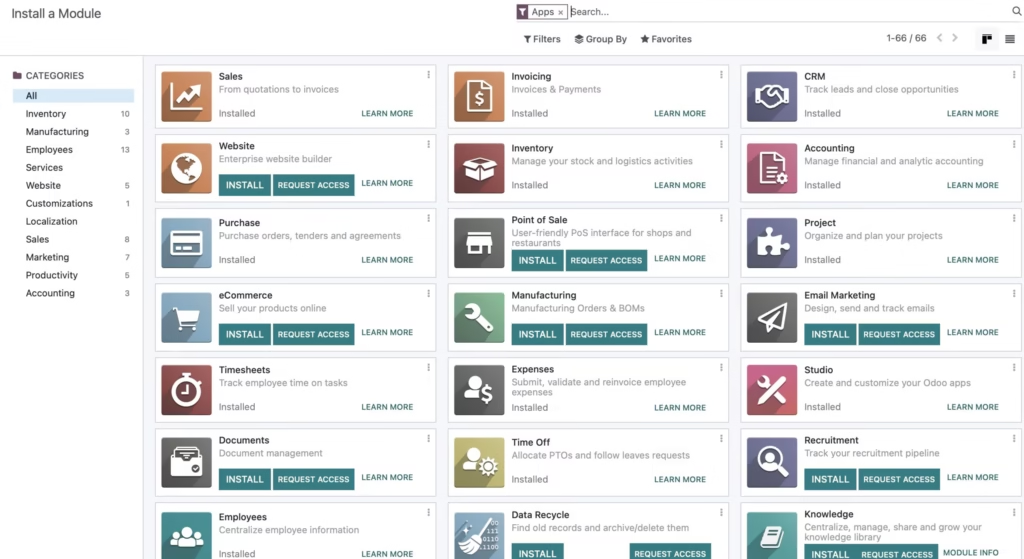
Odoo allows businesses to implement only what they need:
CRM
Sales & Invoicing
Inventory
Manufacturing
HR & Payroll
Accounting
This makes it ideal for SMBs who want control over growth—not complexity.
Manual processes slow teams down. Odoo automates:
Invoicing and follow-ups
Inventory updates
Approval workflows
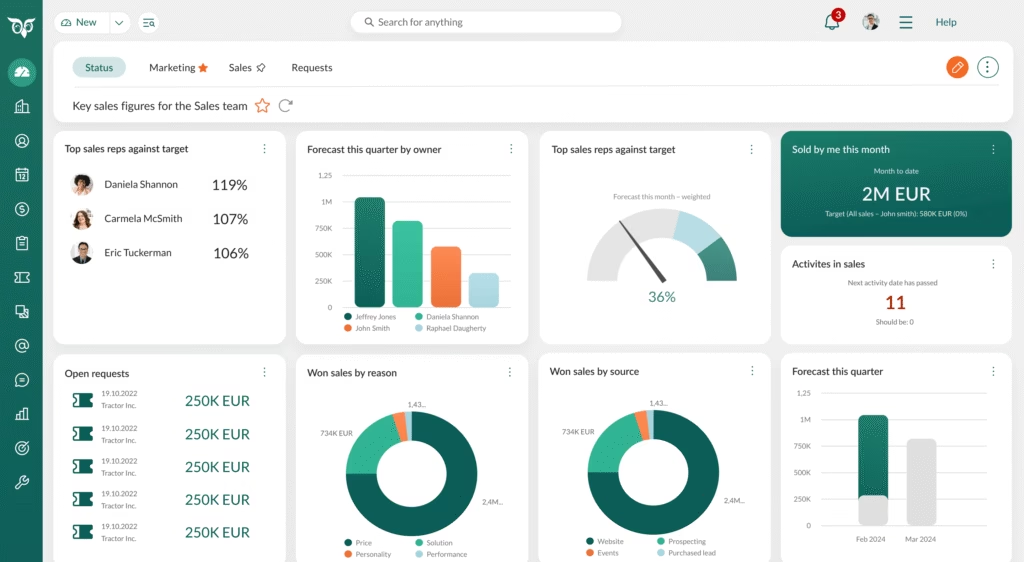
Reporting and dashboards
This leads to faster decisions and fewer operational errors.
Unlike rigid legacy systems, Odoo can be customized safely when implemented correctly—aligning the ERP with your business process instead of forcing change on your team.
Real-time stock visibility
Automated purchase planning
Integrated accounting
Lead-to-invoice workflows
Project tracking
Centralized client data
Production planning
Bill of materials (BoM)
Quality and cost control
In each case, Odoo replaces multiple disconnected tools with a single source of truth.
Lower operational costs over time
Improved decision-making with real-time data
Better user adoption due to modern UI
Flexibility to adapt as business models change
Future-ready architecture for AI, automation, and analytics
For SMBs planning beyond 2026, these benefits are strategic—not just technical.
At Sikdar Technologies, we don’t treat ERP as just software installation.
Our approach is:
Business-first, not feature-first
Focused on process clarity and ROI
Tailored for SMB constraints—budget, time, and team readiness
We help businesses:
Assess whether Odoo is the right fit
Design clean, scalable ERP architecture
Customize responsibly
Ensure smooth user adoption
Our role is to act as a long-term technology partner, not just an implementation vendor.
Legacy systems once supported business growth—but in 2026, they often hold it back.
Odoo ERP is replacing legacy platforms because it aligns with how modern SMBs operate:
Integrated
Scalable
Cost-conscious
Adaptable
The shift isn’t about trends. It’s about building a system that supports your business for the next decade.

For Startups
© 2021-2026 Sikdar Technologies Pvt Ltd