
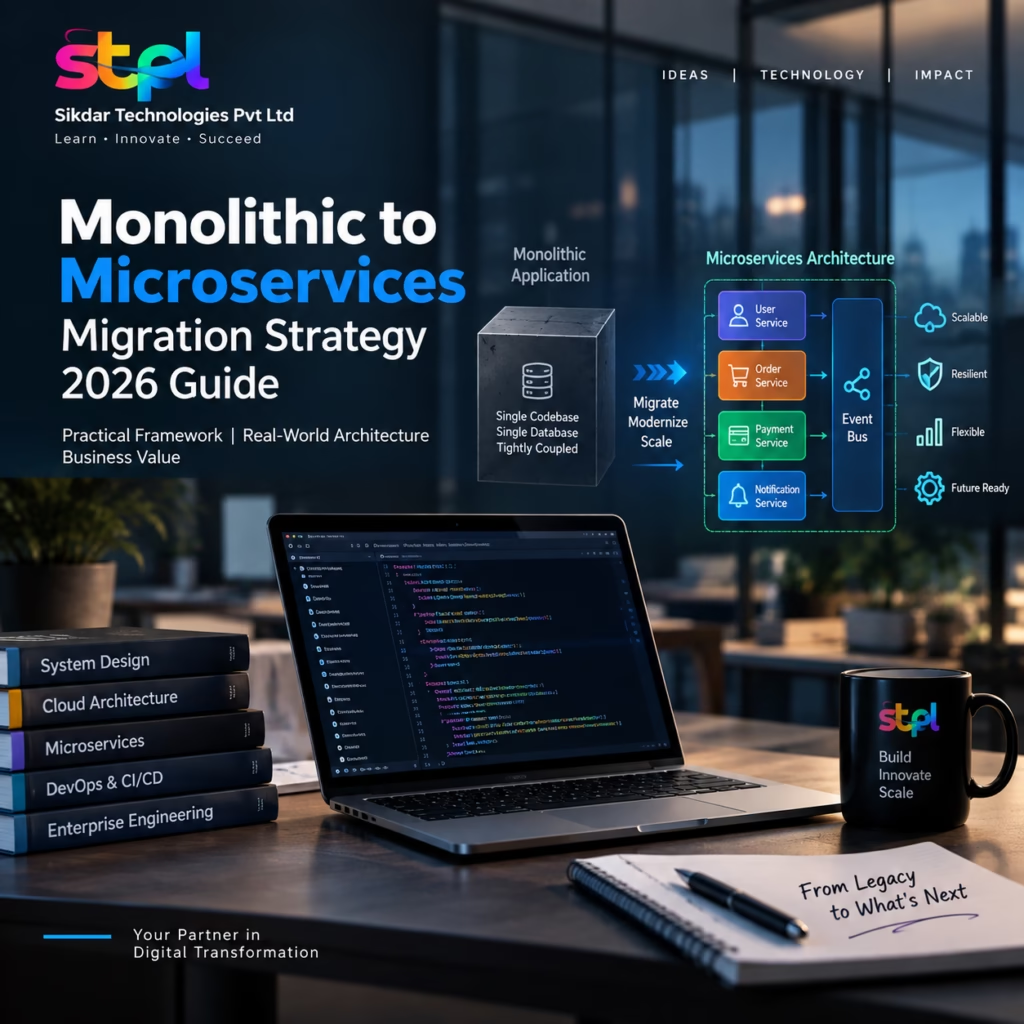
Monolithic to Microservices Migration Strategy: 2026 Guide
Home / Solutions / Monolithic to Microservices Migration ENTERPRISE SOFTWARE MODERNIZATION Modernizing Monolithic Applications to Event-Driven Microservices: Migration Framework A definitive systems engineering roadmap for CTOs and enterprise architects executing a disciplined monolithic to microservices migration strategy without operational disruption. Published: September 2026 Read Time: 18 min read Domain: Enterprise Architecture & Distributed Systems Request an Architecture Audit Schedule Technical Consultation API GATEWAY / PROXY Strangler Interception Layer LEGACY MONOLITH Residual Core Logic NEW MICROSERVICES Autonomous Services EVENT BROKER (Kafka / RabbitMQ / AWS EventBridge) Table of Contents 1. The Modernization Imperative 2. Understanding Monoliths 3. Monolith vs. Modular vs. Microservices 4. When to Modernize 5. The Strangler Fig Pattern 6. Domain-Driven Design Boundaries 7. Event-Driven Communication 8. Database Ownership & State 9. Fault Tolerance & Code Example 10. Distributed AI Alignment 11. Step-by-Step Roadmap 12. Migration Risks 13. Real-World Use Cases 14. Frequently Asked Questions 15. Next Steps Architectural Executive Summary Legacy enterprise applications inevitably encounter structural ceilings: tightly coupled release cycles, deployment blast radiuses that endanger mission-critical workflows, and single-point-of-failure databases. However, attempting a “big-bang” rewrite consistently introduces severe delivery risks and business disruption. A disciplined monolithic to microservices migration strategy leverages the Strangler Fig pattern, Domain-Driven Design (DDD), and asynchronous event streaming. This framework enables engineering organizations to incrementally extract bounded contexts into autonomous microservices while keeping legacy revenue engines online throughout the transition. 1. Why Enterprise Application Modernization Matters For mid-market and enterprise organizations, software assets built over the past decade frequently represent both the company’s core revenue engine and its greatest operational liability. Over years of rapid feature additions, boundaries blur. What began as a structured application degrades into an interconnected codebase where a minor change in the billing module introduces critical defects in inventory management. Modernizing legacy applications is not merely an exercise in upgrading technology stacks; it is an organizational imperative to accelerate feature velocity, improve fault isolation, and enable granular scalability. By migrating to event-driven architectures, organizations transition from synchronous, tightly coupled dependencies to distributed, loosely coupled systems capable of continuous deployment. 2. Understanding Monolithic Applications: Characteristics & Validity A monolithic architecture is a software application where all business logic, data access, user interface handling, and integration components reside within a single codebase, deployed as a single executable artifact, and backed by a single shared relational database. Clients / Web / App HTTP Requests Single Monolithic Deployable Unit Auth Module Orders Module Billing Module Shared In-Process Memory & Database Layer Shared Database Single Point of Failure (High Contention) Figure 1: Traditional Monolithic Application Architecture. All functional domains share an execution process and a single relational database. It is crucial to recognize that monoliths are not inherently defective. For early-stage initiatives, small engineering squads, or products with unproven domain boundaries, a well-structured monolith offers unmatched development velocity, zero network serialization latency, simplified end-to-end testing, and trivial deployment pipelines. The failure occurs when a monolith outgrows the organization’s team structure and operational boundaries, causing severe deployment coupling, scaling bottlenecks, and organizational coordination friction. 3. Monolith vs. Modular Monolith vs. Microservices Enterprise architectural decisions must evaluate operational complexity alongside functional requirements. A distributed system introduces significant operational overhead that must be balanced against its scaling benefits. Evaluation Vector Legacy Monolith Modular Monolith Event-Driven Microservices Codebase Boundary Tightly coupled; shared namespaces and models. Strictly bounded internal modules; explicit interfaces. Completely decoupled, independent code repositories. Data Ownership Single shared schema; direct cross-table joins. Logically isolated schemas; cross-domain queries restricted. Strict database-per-service; zero direct database sharing. Deployment Unit Single unified artifact (all or nothing). Single unified artifact or container. Independently deployed containerized services. Communication In-memory function calls. In-memory function calls or in-process event bus. Asynchronous event broker (Kafka/RabbitMQ) & HTTP/gRPC. Failure Blast Radius Global: A single unhandled exception crashes the runtime. Global runtime, but contained domain logic. Isolated: Failure in one service does not crash peers. Operational Overhead Low (simple CI/CD, basic monitoring). Moderate (enforcing boundaries in code reviews). High (service meshes, distributed tracing, Kubernetes). 4. When Should an Enterprise Modernize? Migrating away from a monolith should be driven by concrete business and engineering signals rather than architectural trends. Organizations should evaluate the following criteria: Deployment Bottlenecks: Multiple teams cannot ship features independently; a single failed test halts the deployment pipeline for dozens of engineers. Disproportionate Resource Scaling: A single compute-heavy capability (such as real-time PDF generation or report crunching) requires scaling the entire application instance, driving up cloud infrastructure expenditure. Domain Blast Radius: Memory leaks or CPU spikes in non-critical components bring down mission-critical checkout or authentication flows. Database Contention: High lock contention, complex stored procedures, and monolithic database connection exhaustion impede vertical hardware scaling. Is Your Legacy Application Ready for Modernization? Understand your current architecture, technical constraints, and modernization options before committing to a migration. Explore our custom software development practice. Request an Architecture Audit 5. The Strangler Fig Migration Pattern The industry gold standard for low-risk legacy modernization is the Strangler Fig pattern (originally described by Martin Fowler). Named after tropical vines that seed in the canopy of a host tree and slowly grow downward until replacing the original host, this pattern replaces monolithic functionality incrementally. Clients Traffic API Routing Gateway Path Inspection /api/v1/legacy/* /api/v2/orders/* (New) Legacy Monolithic Application Users • Catalog • (Orders Deprecated) • Invoicing Shrinking Scope Over Time Extracted Orders Microservice Autonomous Service Boundary Dedicated Orders DB Publishes Domain Events Figure 2: The Strangler Fig Migration Pattern. The API Gateway transparently routes extracted paths to new microservices while passing legacy traffic unchanged. The pattern operates through three continuous mechanisms: Transform: Construct a new microservice implementing a targeted business capability using modern cloud-native standards. Coexist: Insert an API gateway or reverse proxy in front of the infrastructure. The gateway intercepts incoming HTTP/REST requests, routing legacy endpoints to the monolith and newly implemented endpoints to the microservice. Eliminate: Once the new service demonstrates production stability and data consistency, deprecate and safely remove the redundant code from the monolithic codebase. 6. Domain-Driven Design & Service Boundaries The most common mistake in microservices migrations is